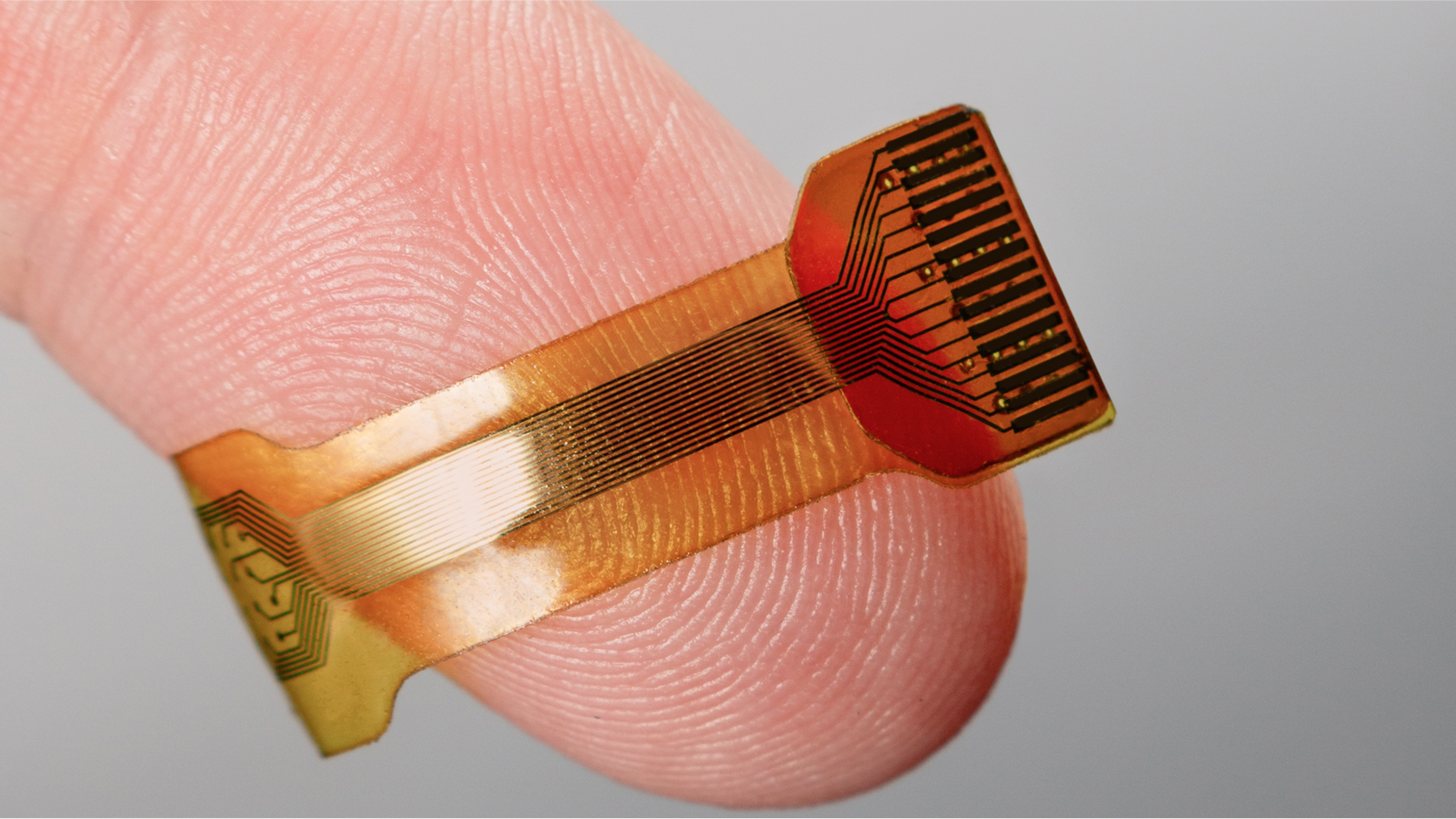
The Neiry Group is preparing to adopt and secure intellectual property rights for innovative thin-film electrodesdeveloped by one of our technological (scientific) partners. These new electrodes open up vast prospects for the development of neurointerfaces and biomedical technologies in Russia.
Key features of the innovation:
Based on these electrodes, we are developing a bidirectional brain-computer interface capable of both reading signalsfrom nerve cells and sending back stimulating impulses — enabling a fully functional connection between a computer and a living organism.
A distinguishing feature of Neiry’s development is the presence of built-in microchips inside each electrode. These chips perform local signal amplification and digitization, allowing part of the electronics to be placed directly inside the body, close to the source of neural activity. This design provides a significant advantage over Western analogues, such as the products developed by NeuroOne.
We are confident that this technology will become the foundation for a new generation of brain-computer interfacesand make a significant contribution to the advancement of neurotechnology.
Key features of the innovation:
- Ultra-thin design: The electrode thickness is just 15 micrometers — several times thinner than a human hair.
- Cost-efficient production: Thanks to a patented thin-film processing technology, the production cost is dozens of times lower than that of conventional solutions.
- Safe materials: All electrode components are made from modern, biocompatible materials widely used in microelectronics and approved for use in medical devices.
Based on these electrodes, we are developing a bidirectional brain-computer interface capable of both reading signalsfrom nerve cells and sending back stimulating impulses — enabling a fully functional connection between a computer and a living organism.
A distinguishing feature of Neiry’s development is the presence of built-in microchips inside each electrode. These chips perform local signal amplification and digitization, allowing part of the electronics to be placed directly inside the body, close to the source of neural activity. This design provides a significant advantage over Western analogues, such as the products developed by NeuroOne.
We are confident that this technology will become the foundation for a new generation of brain-computer interfacesand make a significant contribution to the advancement of neurotechnology.