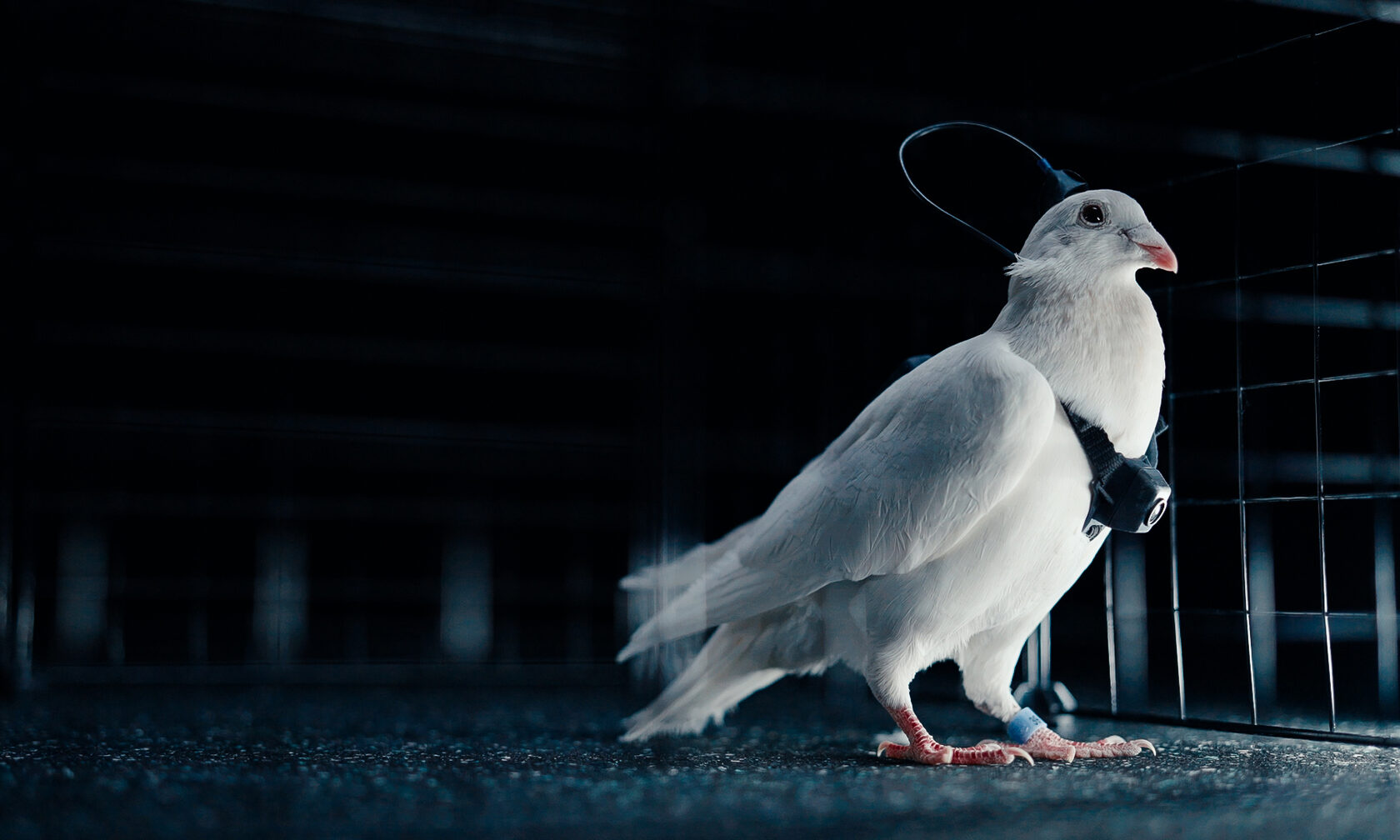
Neiry, an international deeptech company with offices in Dubai and Moscow, has begun early real-world use of a new platform that uses live birds equipped with implanted neural interfaces, along with compact electronic imaging modules in a small backpack-style unit. The goal is to apply biological carriers in situations where mechanical drones face range, weight, or other limitations.
The initial tests involve pigeons fitted with a small controller, solar panels mounted on the bird’s back, and a camera comparable to the ones already present in public spaces. The interface provides mild stimulation to selected brain regions, prompting the bird to prefer a certain direction. The bird otherwise behaves naturally, the system just guides it toward a preset route. If imaging is activated, identifiable details are filtered out on-device to comply with local privacy regulations.
Unlike traditional UAVs, biological carriers do not require battery swaps or frequent landings, and their natural flight behavior makes them suitable for long-duration routes – up to 400 km without stops daily. Neiry is evaluating potential applications such as infrastructure inspections, search-and-rescue support, coastal and environmental observation, and remote-area monitoring.
While research involving implanted neural interfaces in birds has appeared in academic settings internationally, it has remained largely experimental. Neiry’s work focuses on adapting these concepts for practical use.
The company has conducted limited test flights in Russia and CIS countries to evaluate distance, stability, and data transmission. The birds continue their normal routines outside flights and are cared for by operators between missions.
“Our current focus is pigeons, but different species may be used depending on the environment or payload,” said Alexander Panov, founder of Neiry Group. “With the system ready for real-world deployment, this versatility becomes especially relevant in the scenarios where conventional drones face physical constraints.”
The system is ready for practical use, and Neiry sees strong potential for its application in large, monitoring-intensive markets such as Brazil and India, particularly in utilities, logistics, agriculture, and emergency response.
The initial tests involve pigeons fitted with a small controller, solar panels mounted on the bird’s back, and a camera comparable to the ones already present in public spaces. The interface provides mild stimulation to selected brain regions, prompting the bird to prefer a certain direction. The bird otherwise behaves naturally, the system just guides it toward a preset route. If imaging is activated, identifiable details are filtered out on-device to comply with local privacy regulations.
Unlike traditional UAVs, biological carriers do not require battery swaps or frequent landings, and their natural flight behavior makes them suitable for long-duration routes – up to 400 km without stops daily. Neiry is evaluating potential applications such as infrastructure inspections, search-and-rescue support, coastal and environmental observation, and remote-area monitoring.
While research involving implanted neural interfaces in birds has appeared in academic settings internationally, it has remained largely experimental. Neiry’s work focuses on adapting these concepts for practical use.
The company has conducted limited test flights in Russia and CIS countries to evaluate distance, stability, and data transmission. The birds continue their normal routines outside flights and are cared for by operators between missions.
“Our current focus is pigeons, but different species may be used depending on the environment or payload,” said Alexander Panov, founder of Neiry Group. “With the system ready for real-world deployment, this versatility becomes especially relevant in the scenarios where conventional drones face physical constraints.”
The system is ready for practical use, and Neiry sees strong potential for its application in large, monitoring-intensive markets such as Brazil and India, particularly in utilities, logistics, agriculture, and emergency response.